Europe58


 +27
+27The GDPR sets the global standard for data protection, requiring explicit opt-in consent before processing personal data of EU/EEA residents. For websites, non-essential cookies must be blocked until visitors actively consent. Pre-ticked boxes and implied consent are invalid.

PECR is the UK's cookie-specific law, requiring consent before storing or accessing cookies. The DUAA 2025 significantly increased penalties from GBP 500,000 to GBP 17.5 million and introduced analytics exceptions on an opt-out basis. Only strictly necessary cookies are exempt.
+27Article 5(3) of the ePrivacy Directive is the primary EU legal basis requiring cookie consent. It mandates prior informed consent before storing or accessing any information on a user's device, with narrow exceptions only for transmission necessity and explicitly requested services.

France has the most actively enforced cookie regime in Europe. CNIL issued 259 corrective decisions in 2025, with cookie-specific fines totaling EUR 486.8 million including EUR 325M against Google. A Refuse all button or Continue without accepting must appear on the first layer.
The UK GDPR is the retained EU GDPR post-Brexit, with consent standards identical to the EU version. The UK adequacy decision was renewed December 2025, valid until December 2031. Combined with PECR, it forms the legal framework for cookie consent in the UK.

Ireland implements the ePrivacy Directive through SI 336/2011. The DPC is the lead supervisory authority for major tech companies headquartered in Ireland including Meta, Google, Apple, and Microsoft. Uniquely, cookie consent is limited to 6 months and must then be refreshed.

Germany implements the ePrivacy Directive through Section 25 of TDDDG (renamed from TTDSG in May 2024). A Consent Management Ordinance (EinwV) became effective April 2025, establishing a voluntary framework for recognized consent management services. Cookie banners must not obscure website content.

Turkey's KVKK is modeled on the GDPR but lacks specific cookie legislation. Cookies processing personal data require explicit consent. The 2024-2025 amendments strengthened the framework with cross-border transfer rules, expanded personal data definitions, and data portability rights. Data controllers must register with VERBIS before processing.

Spain implements the ePrivacy Directive through Article 22 of the LSSI. Cookie violations are classified as slight offenses with EUR 30,000 fines per URL, but multiple URLs multiply penalties. AEPD allows consent-exempt analytics under privacy-friendly configurations, similar to CNIL.

Italy implements the ePrivacy Directive through Article 122 of the Privacy Code with detailed Garante cookie guidelines effective January 2022. Only technically necessary cookies may load by default. Scrolling is not valid consent, and closing a banner with "X" closes it without granting consent.

Switzerland has no cookie-specific legislation equivalent to the ePrivacy Directive. The FDPIC issued cookie guidelines in January 2025 establishing a tiered consent model: essential cookies need only disclosure, functional cookies allow opt-out, and advertising/profiling cookies require explicit consent. Legitimate interest may justify some non-essential cookies, unlike EU law.

The Netherlands implements the ePrivacy Directive through Article 11.7a of the Telecommunications Act. The AP launched a major enforcement sweep in April 2025, warning 50 organizations for misleading cookie banners or placing tracking cookies without consent. Cookie walls are not permitted.
Belgium enforces strict cookie consent with one of the EU's most active DPAs. Cookie walls are prohibited, and a Reject all button must appear on the first layer with equal prominence to Accept all. Dark patterns in cookie banners are actively enforced against.

Russia's 152-FZ does not explicitly address cookies, but Roskomnadzor interprets cookies as personal data when they contain identifying information. Russia's strict data localization requirements add an additional compliance layer: personal data of Russian citizens must be stored on Russian servers.

Portugal implements the ePrivacy Directive through Law 41/2004, with a distinctive tiered penalty structure distinguishing between large companies, SMEs, and natural persons. The CNPD issued 90 fines totaling EUR 559,950 in 2023, demonstrating active enforcement.

Norway's January 2025 amendment to Ekomloven marked a major shift from tolerating passive consent to strict opt-in. Pre-ticked boxes and browser settings are now explicitly invalid. Accept and reject options must have equal prominence. Datatilsynet sanctioned 6 websites for tracking pixel violations.

Poland implements the ePrivacy Directive through Articles 173-174 of the Telecommunications Law. While Article 173(2) technically permits consent via browser settings, PUODO recommends active consent. Since 2019, Article 174 requires cookie consent to meet full GDPR standards.

Denmark implements the ePrivacy Directive through the Cookie Order (Cookiebekendtgørelsen), administered by the Danish Business Authority. Cookie consent is a declared 2026 enforcement priority for Datatilsynet, which will examine whether Danish websites give users a genuine choice.

Sweden implements the ePrivacy Directive through Chapter 9 Section 28 of LEK. In April 2025, IMY issued a landmark reprimand against Aller Media for dark patterns in cookie banners. Less than 25% of Swedish users accept cookies, reflecting strong privacy awareness.

Romania has historically been one of the more permissive EU countries on cookies, but ANSPDCP tightened enforcement in 2025-2026 with multiple fines for installing non-essential cookies without consent. Browser settings were previously considered potentially sufficient but this interpretation is no longer viable.

Greece implements the ePrivacy Directive through Law 3471/2006. The HDPA issued detailed Recommendation 1/2020 with best and worst practice guidance for cookie management. Scrolling is not valid consent, and information must cover purpose, duration, controller identity, and data recipients for each cookie separately.

Hungary implements the ePrivacy Directive through Section 155 of Act C of 2003. NAIH actively enforces cookie requirements with a focus on dark patterns and equal accessibility of consent options. Reject All must be equally accessible as Accept All in cookie banners.

Luxembourg implements the ePrivacy Directive through the Act of 30 May 2005. The CNPD requires both I accept all and I refuse all on the first layer of cookie banners. Consent validity is limited to a maximum of 12 months, making Luxembourg one of the few countries with an explicit expiration period.
The Czech Republic shifted from implied consent via browser settings to full opt-in consent on January 1, 2022. Section 89(3) now requires GDPR-compliant prior consent before storing cookies. The UOOU began imposing fines on non-compliant websites in 2023.
Austria implements EU cookie consent through Section 165(3) of TKG 2021, requiring opt-in consent for all non-essential cookies. A split enforcement model assigns TKG cookie violations to the Fernmeldebüro and GDPR aspects to the DSB. Cookie-specific fines are capped at EUR 50,000.
Croatia's ZEK implements the ePrivacy Directive with specific cookie provisions. AZOP has been actively enforcing cookie requirements, imposing fines on companies for inadequate consent mechanisms including unclear purpose descriptions and processing data before obtaining consent.

Finland implements the ePrivacy Directive through Section 205 of the Information Society Code with notably strict interpretations. Browser settings are explicitly insufficient for consent, and legitimate interest is not a valid legal basis for cookies, stricter than many EU countries.

Iceland implements the GDPR through Act 90/2018 as part of its EEA obligations. Cookies can only be used with informed consent, except where strictly necessary. Iceland's penalty cap at 2% of turnover (versus the EU's 4%) reflects its EEA rather than EU membership. Daily penalty fines are available for ongoing non-compliance.

Ukraine's Law 2297-VI is the primary data protection law but lacks cookie-specific provisions. Current penalties are extremely low (~EUR 700). A GDPR-aligned replacement draft was adopted as a basis in November 2024, proposing penalties up to 8% of turnover. Ukraine is an EU candidate country.

Estonia transposes the ePrivacy Directive through the Electronic Communications Act, requiring prior voluntary consent for supplementary cookies. The AKI categorizes cookies into essential and supplementary types, with comprehensive information requirements including cookie duration and third-party access.

Malta implements the ePrivacy Directive through S.L. 586.01, regulating cookie storage and access on user devices. Cookie walls are prohibited, and the fine structure includes both per-violation and per-day-of-continuation penalties, creating strong incentives for prompt compliance.

Lithuania implements the ePrivacy Directive through the Law on Electronic Communications. Cookie-specific penalties under national law are notably low (EUR 150-1,150), though GDPR fines apply when personal data is involved. The VDAI has published recommendations with samples of correct and incorrect consent practices.

Latvia implements the ePrivacy Directive through the Law on Information Society Services (LISS), requiring express prior consent before placing cookies. A 2021 DVI audit of 29 websites found all 26 major e-merchants in violation of cookie requirements.
Bulgaria transposes the ePrivacy Directive through two laws: the Electronic Commerce Act and the Electronic Communications Act. The CPDP has been increasingly active in enforcement, though national cookie penalties remain modest compared to GDPR maximums.

Albania enacted one of the most GDPR-aligned laws outside the EU/EEA in December 2024, incorporating both the GDPR and the Law Enforcement Directive. Penalties match GDPR levels at up to 4% of global turnover. Direct electronic marketing requires prior explicit consent with easy opt-out. Albania is an EU candidate country.
Serbia's ZZPL is modeled on GDPR principles but with significantly lower penalties. Websites tracking visitors with cookies must obtain consent via interactive banners. Cookie-specific legislation is being drafted as of early 2025. Serbia is an EU candidate country with GDPR alignment expected during accession.
Slovenia was the last EU member state to adopt GDPR implementing legislation, with ZVOP-2 entering into force on January 26, 2023. ZEKom-2 implements the ePrivacy Directive. The national maximum fine of EUR 40,000 is the lowest in the EU, though GDPR-level fines can now be imposed through ZVOP-2.
Cyprus implements the ePrivacy Directive through Section 14 of L.112(I)/2004. The Commissioner for Personal Data Protection has conducted active cookie inspections since June 2021, with a strict stance that analytics cookies require prior consent. Penalties can reach EUR 200,000.

Slovakia replaced its previous Electronic Communications Act with Act 452/2021, effective February 2022. The Act requires active opt-in consent before cookies may be placed. Data collection cannot begin until the user gives active consent meeting GDPR standards.
Bosnia and Herzegovina adopted a new GDPR-aligned Data Protection Act in January 2025, with enforcement beginning October 2025. The law aligns with both the GDPR and the Law Enforcement Directive, establishing GDPR-level penalties. The AZLP has been granted significant enforcement powers.

Belarus's Law 99-Z is the country's first dedicated data protection law. It requires consent with detailed pre-consent disclosures and uniquely imposes criminal liability for unlawful data handling, with penalties up to 5 years imprisonment. Administrative fines are low but criminal sanctions are severe.

Montenegro adopted a new GDPR-aligned Personal Data Protection Act in 2023, replacing the previous PDPL. The AZLP gained administrative enforcement powers and can impose fines directly. However, maximum penalties remain modest at EUR 20,000, significantly below GDPR levels.

Georgia's Law 3144/2023 is a GDPR-aligned data protection law entering force in phases from March 2024. While it lacks specific cookie legislation, websites must obtain consent for non-essential cookies processing personal data. Financial penalties are modest but criminal penalties including imprisonment are available for severe violations.

Guernsey has a GDPR-equivalent data protection regime with EU adequacy since 2003, one of the longest-standing adequacy decisions globally. UK adequacy is also granted. The ODPA provides independent enforcement for this UK Crown Dependency.

Gibraltar applied the EU GDPR domestically post-Brexit, creating a full GDPR-equivalent regime for this British Overseas Territory. The consent age is lowered to 13 (versus GDPR's 16). ePrivacy-equivalent provisions apply to cookies.

The Isle of Man applied the GDPR directly into domestic law, creating a uniquely direct GDPR implementation for a non-EU jurisdiction. Both EU and UK adequacy decisions are granted. The independent Information Commissioner enforces ePrivacy-equivalent cookie provisions.

Jersey has a GDPR-equivalent data protection regime with both EU and UK adequacy decisions in force. The DPJL provides full data subject rights, mandatory breach notification, and independent oversight by the JOIC. One of the longest-standing adequacy relationships with the EU.

Liechtenstein implements the GDPR through its Data Protection Act 2018 and the ePrivacy Directive through the Communications Act (KomG). While the DSG is fully GDPR-aligned, the KomG has not been fully updated for the 2009 ePrivacy amendments, creating a potential gap in cookie-specific requirements.
Moldova enacted a comprehensive GDPR-aligned data protection law in 2024 with a two-year transition period before enforcement begins August 2026. The law transposes the GDPR including explicit consent requirements, purpose limitation, and data minimization. Cookie requirements derive from general consent provisions.
Kosovo's Law 06/L-082 transposes the EU GDPR, applying to both private and public bodies including diplomatic offices. The AIP is the independent enforcement authority. Maximum penalties are capped at EUR 40,000 per violation, well below GDPR levels. The AIP actively handles complaints and conducts investigations.

North Macedonia's ZZLP fully aligns with the EU GDPR, with GDPR-mirrored penalty tiers of 2% and 4% of annual income. The DZLP has faced enforcement challenges and primarily issues warnings rather than fines. Businesses must provide privacy notices on website arrival. North Macedonia is an EU candidate country.

San Marino has a data protection framework with an active DPA and is a member of Council of Europe Convention 108+. While not an EU member, its framework provides consent-based data protection with recognized international standards.

Monaco updated its data protection law in 2024, replacing the 2011 legislation with a framework providing strong protection similar to the GDPR. The CCIN serves as the independent enforcement authority. Monaco is not an EU member but has its own comprehensive data protection regime.

Vatican City State's first general data protection regulation (Decree DCLVII, 2024) is GDPR-principled and consent-based by default. Real-world commercial-web relevance is minimal; included for catalog completeness.

Andorra's comprehensive data protection law replaces earlier legislation with a GDPR-aligned framework. The APDA is an independent active DPA. Andorra is not an EU or EEA member but maintains close alignment with EU standards. No EU adequacy decision has been granted yet.

Azerbaijan's data protection law establishes a consent-based framework for processing personal information. Notably, the DPA operates under the President's office rather than being independent, which differs from the EU model of independent supervisory authorities.

The Faroe Islands have a separate GDPR-aligned data protection framework, distinct from Denmark's domestic GDPR implementation despite being a Danish self-governing territory. An EU adequacy decision has been granted, enabling smooth data transfers with the EU.

Armenia's data protection law requires prior express consent for processing personal data. It has a dedicated enforcement agency and is part of broader EU integration efforts through the EU-Armenia association agreement framework.
US State Laws2

CIPA is a 1967 California chapter covering wiretapping, eavesdropping, and other privacy invasions, not a website-specific law. Since 2022, courts have applied two of its sections to website chat, analytics, and ad tools, and any visitor can sue directly for at least $5,000 per violation, no revenue threshold.
Washington's sector-specific health data privacy law has the broadest health data definition among US laws. Requires opt-in consent for ALL consumer health data collection, sharing, and sale. Uniquely prohibits geofencing within 2,000 feet of healthcare facilities. Provides a private right of action.
North America6

Canada's federal private-sector privacy law based on 10 fair information principles. Requires express consent for sensitive data and implied consent for less sensitive data. OPC guidance addresses cookies and online behavioral advertising. The CPPA replacement bill died January 2025; a new bill is expected.
Quebec's Law 25 is the strictest privacy law in Canada and the closest North American equivalent to the GDPR. Consent must be clear, free, informed and requested for each purpose, and any technology that identifies, locates or profiles a visitor has to be disclosed. Its privacy-by-default rule carves out browser cookie settings, but non-essential cookies still need consent first.
COPPA is the primary US federal law protecting children's online privacy. It requires verifiable parental consent before collecting personal information from children under 13. Persistent identifiers including cookies are classified as personal information. The 2025 amendments expand protections significantly.
British Columbia's PIPA is recognized as substantially similar to PIPEDA. The OIPC can investigate complaints, conduct audits, issue binding orders, and require compliance. Nonprofits engaging in commercial activities are also covered. Organizations must destroy personal information once the original purpose is fulfilled.
Alberta's PIPA is recognized as substantially similar to PIPEDA, covering provincially regulated private-sector organizations. The OIPC has binding order-making power, stronger than PIPEDA's OPC which issues only recommendations. Express consent is required for sensitive data, implied for non-sensitive.
FERPA protects student education records at federally funded institutions. Written consent is required before disclosing personally identifiable information from education records. The sole enforcement mechanism is withdrawal of federal education funding, a penalty so severe it has never been imposed.
Asia Pacific24

China's PIPL is one of three pillars alongside the CSL and DSL forming China's data governance framework. Non-essential cookies must be blocked until visitors actively opt in. Simply stating cookie use in a privacy policy is insufficient. Separate consent is required for sensitive data, cross-border transfers, public disclosure, and third-party provision.

South Korea's PIPA was amended in February 2026 to introduce the world's highest potential penalty ceiling at 10% of total revenue for severe violations. Cookie data qualifies as personal information when combinable with other data to identify individuals. CEO accountability is now statutory: the CEO is designated as the ultimate responsible person.

Japan's APPI governs personal information handling with specific cookie/tracking provisions added by the 2023 Telecommunications Business Act. Consent is required before providing cookies, IPs, and device IDs to parties that will link them to identified users. The PPC conducts mandatory three-year review cycles.

Australia's December 2024 amendments are the most significant since the Act's inception. Personal information now explicitly includes IPs, device IDs, and cookie identifiers. Pre-ticked boxes and dark patterns are restricted. A new statutory tort for serious privacy invasion creates a private right of action. Penalties can reach AUD 50 million or 30% of turnover.

Indonesia's first comprehensive data protection law provides individuals greater control over personal data. Explicit, informed, specific consent is required including for cookies collecting personal data. Despite the transitional period ending October 2024, the Indonesian DPA has not yet been established, creating a current enforcement gap.

Thailand's PDPA is modeled on the GDPR and requires explicit consent before processing personal data through cookies. Consent must be unambiguous and via affirmative action. Enforcement intensified significantly in 2025, with THB 21.5 million in fines in August 2025 alone. Withdrawal of consent must be as easy as giving it.

Taiwan's PDPA governs personal data across both government and private sectors. The November 2025 amendments are the most significant reform since 2010, establishing Taiwan's first independent data protection authority (PDPC) and making breach notification mandatory rather than discretionary.

Hong Kong's PDPO is built around six Data Protection Principles covering collection, accuracy, use, security, transparency, and access. Cookies collecting personal data require clear notices and consent. The 2021 amendment added strong anti-doxxing provisions with criminal sanctions up to HKD 1 million and 5 years imprisonment.

India's first comprehensive data protection law requires explicit consent that is freely given, unconditional, informed, and unambiguous. Cookie consent requires affirmative action like clicking Accept Cookies. Consent managers, certified entities helping individuals manage consent across platforms, are a distinctive feature. Full compliance required by May 2027 with no grace period.
The CSL establishes China's legal framework for cybersecurity obligations including network security, critical infrastructure protection, and data security. The January 2026 amendments represent the first major overhaul since 2017, significantly increasing penalties and broadening extraterritorial enforcement. Cookie-specific requirements are addressed by the PIPL.
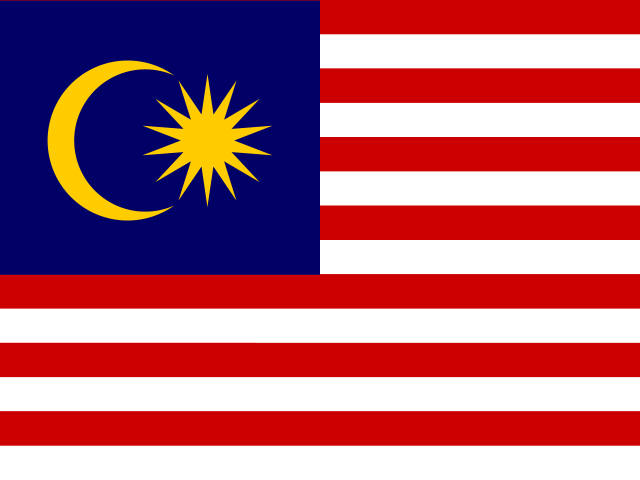
Malaysia's PDPA was significantly overhauled by the 2024 Amendment Act, introducing mandatory DPOs, breach notification, data portability, and enhanced penalties (MYR 1M, up from 300K). Consent mechanisms must now meet updated standards for granular, specific, and withdrawable consent. Phased implementation runs January-June 2025.

The Philippines DPA requires consent via clear affirmative action with layered privacy notices at or before cookie deployment. One of the few Asian data protection laws with criminal sanctions: up to 6 years imprisonment for sensitive data violations. The NPC has not yet finalized dedicated cookie regulations but actively issues guidance.

Vietnam's PDPL elevates data protection from a decree to comprehensive law level. Consent must be voluntary, clear, and in text or verifiable electronic format. Silence does not constitute consent. Cross-border transfer violations carry up to 5% of revenue penalties. The law covers AI and blockchain technologies.

Bangladesh's first comprehensive data protection framework, promulgated as an ordinance under constitutional powers. Every citizen is recognized as the rightful owner of their personal data, making explicit consent mandatory. Profiling, behavioral tracking, and targeted advertising directed at minors are explicitly prohibited.
The DSL establishes China's data security governance framework with a classification system for core, important, and general data. For website operators, it primarily affects how collected data is stored and secured rather than how consent is obtained. Cookie-specific consent is addressed by the PIPL.

Brunei's PDPO 2025 is the country's first comprehensive data protection law for the private sector, modeled on Singapore's PDPA. Organizations have a one-year grace period for compliance. The last major ASEAN economy to enact comprehensive data protection legislation.

Sri Lanka was the first South Asian country to pass comprehensive privacy legislation in 2022. However, core enforcement provisions were delayed. The March 2025 enforcement date was repealed just four days before taking effect, creating uncertainty about the practical timeline. The DPA was appointed in early 2024.
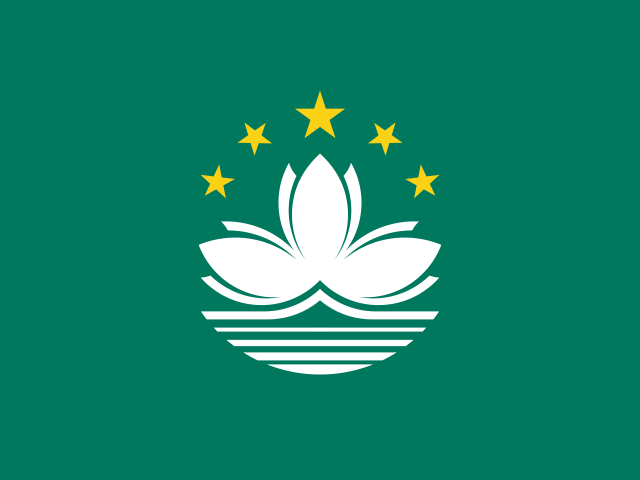
Macau's PDPA is modeled on the Portuguese Data Protection Act (based on EU Directive 95/46/EC), giving it one of Asia's most explicitly EU-style cookie consent frameworks. Article 6 exempts strictly necessary cookies but requires consent for all other cookies. Controllers must register with the GPDP before processing.
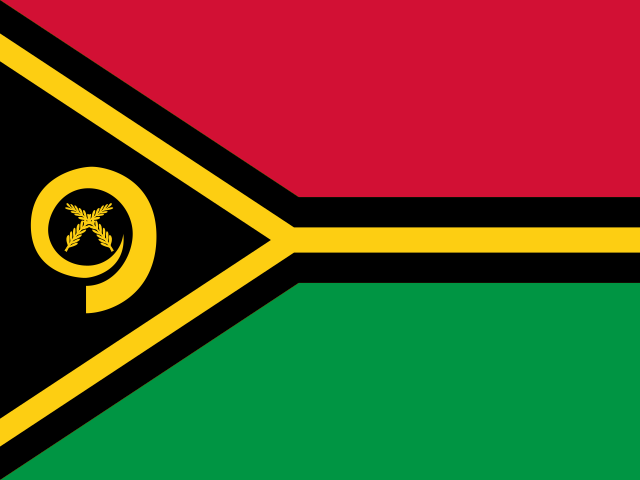
Vanuatu's Data Protection and Privacy Act 2024 is a new consent-based regime for the public and private sectors, implying opt-in for non-essential website cookies.

Tonga's first comprehensive privacy law, the Privacy Act 2025, is consent-based, requiring prior consent to process personal data and implying opt-in for non-essential website cookies.

Mongolia's PDPL replaced the 1995 Law on Personal Secrecy with a comprehensive framework. Requires written or electronic consent before collecting personal data including through cookies. Data collection is limited to what is strictly necessary, and cross-border transfers require data subject consent.
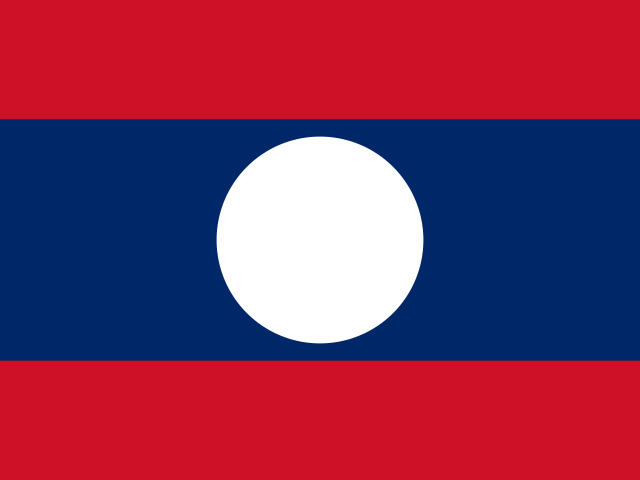
Laos's LEDP outlines principles for electronic data protection with opt-out rights but does not mandate prior opt-in consent. It classifies electronic data into categories and establishes data controller responsibilities. The law is considered limited in scope and enforcement compared to more modern ASEAN data protection laws.

The Maldives has a basic Data Protection Act (2017) outlining principles for data collection, use, and disclosure. It is not a comprehensive GDPR-style law. A more robust Privacy and Personal Data Protection Bill was released for consultation in 2023 but has not been enacted.

Nepal's Privacy Act covers both physical and informational privacy but has significant limitations in the digital context. Critically, the law explicitly does NOT cover IP addresses, cookies, location data, or online identifiers, making it largely irrelevant to website consent management. Penalties are among the lowest globally.
Latin America & Caribbean30

Brazil's LGPD is modeled after the GDPR with extraterritorial scope. Requires explicit consent with separate authorization per processing purpose. Non-essential cookies require prior consent per ANPD guidance. Penalties include publicization of the infraction, creating reputational risk beyond fines.

Colombia's comprehensive data protection law with active SIC enforcement. Requires prior, express, and informed consent for all processing including cookies. The SIC has broad investigative powers including on-site inspections. Authorization logs are required for cookies, and a pop-up must inform users about privacy and cookie management.

Completely new data protection law enacted March 2025, replacing the 2010 version. The INAI was dissolved and replaced by Transparencia para el Pueblo. Introduces criminal penalties, specialized federal data protection courts, and doubled fines for sensitive data violations. Express consent required for sensitive data; implied consent available for non-sensitive.

A complete overhaul of Chile's data protection framework replacing the 1999 law. Creates a new dedicated Data Protection Agency, introduces tiered penalties, and explicitly prohibits pre-ticked consent boxes. The agency must issue cookie guidelines. Takes effect December 2026 after a 24-month implementation period.

Peru's data protection law was significantly strengthened in 2025 with updated regulations introducing phased DPO requirements, extraterritorial scope, and the tightest breach notification timeline in the region. Foreign companies serving Peruvian individuals must appoint local representatives. Maximum penalty is 10% of annual net income.

The most comprehensive data protection law in the Caribbean, with GDPR-level penalties (4% of worldwide turnover). Individual violators face both fines and up to 10 years imprisonment. The OIC operates independently with broad enforcement powers including assessment notices, information notices, and criminal prosecution.

One of the earliest comprehensive data protection laws in Latin America, granting Argentina EU adequacy since 2003. The law is increasingly outdated, and reform bills submitted in 2025 would introduce GDPR-aligned penalties of up to 4% of turnover. Current penalties under the original law are low.

Ecuador's LOPDP requires all organizations to implement a Comprehensive Personal Data Protection System (SPDP) by December 2025. After initially zero sanctions, recent fines against LigaPro (~$250K) and the Football Federation (~$200K) demonstrate increasing enforcement. DPO registration is required on the authority's digital platform.
Paraguay's first comprehensive data protection law (Ley 7593/2025), promulgated November 2025 with a two-year vacatio legis, becomes enforceable around November 2027. GDPR/LGPD-modeled with prior consent, implying opt-in for non-essential website cookies.
Uruguay's data protection law earned EU adequacy in 2012. Features mandatory database registration with quarterly updates and graduated enforcement from warning through database closure. Uruguay also ratified Convention 108+ for additional international alignment.
Costa Rica's data protection law requires informed and express consent for all processing including cookies and online tracking. Organizations must register databases with PRODHAB. PRODHAB can suspend data processing for up to 6 months for serious violations. Breach notification is required within 5 business days.
El Salvador's comprehensive data protection law (Decreto 144), in force since November 2024, requires prior consent to process personal data. For websites this implies opt-in consent before non-essential cookies load.

Barbados's data protection law requires mandatory breach notification within 72 hours (GDPR-aligned) and registration with the Data Protection Commissioner before processing. Penalties range widely from BD $10,000 to $500,000 with criminal sanctions including 2 months to 3 years imprisonment.

Bermuda's PIPA became fully effective January 2025 after phased implementation from 2016. Requires clear, free, and informed consent with mandatory privacy officer designation. Failure to notify breaches is a criminal offense. Court-ordered compensation is available for financial loss or emotional distress.

The Cayman Islands' data protection law was designed with EU adequacy in mind. The Ombudsman has substantial enforcement powers including information orders, enforcement orders, inspection and seizure powers, and monetary penalties. Data breach notification is required within 5 days.

Panama's data protection law establishes principles including loyalty, purpose limitation, proportionality, and transparency. ANTAI oversees enforcement with powers to conduct inspections and approve cross-border transfers. Violations are classified into minor (3-year expiry), serious (5-year expiry), and very serious (no prescription).
Belize's Data Protection Act 2021 is a GDPR-style consent-based law requiring prior consent to process personal data, implying opt-in for non-essential website cookies.
Cuba's Ley 149/2022, effective February 2023, is a consent-based data protection law. Processing personal data requires prior consent, implying opt-in for non-essential website cookies.

The Dominican Republic has a comprehensive data protection framework inspired by European standards, but lacks a dedicated supervisory authority, creating a significant enforcement gap. Criminal sanctions of 6 months to 2 years imprisonment are available. The Bank Superintendency handles only credit bureau violations.

Guyana's Data Protection Act 2023 was assented in August 2023 but has not been brought into force (no commencement order as of 2026). Once operative it is consent-based, implying opt-in for non-essential website cookies.
Nicaragua's Ley 787 is a consent-based data protection law requiring prior consent to process personal data, implying opt-in for non-essential website cookies.

Saint Lucia's Data Protection Act 2011 was brought into force in 2023. It is consent-based, requiring prior consent to process personal data, implying opt-in for non-essential website cookies.

Antigua and Barbuda's data protection law establishes a framework for personal data processing with the Information Commissioner as enforcement authority. Features both summary and indictable offense categories with escalating penalties, including up to 5 years imprisonment for serious violations.

The Bahamas' original data protection law is over 20 years old and increasingly outdated. It establishes basic principles for fair and lawful collection, accuracy, and secure storage. A comprehensive GDPR-inspired replacement bill (Data Protection Bill, 2025) is under public consultation covering AI, biometrics, and cloud computing.

The Wbp BES governs personal data in the Caribbean Netherlands (the special municipalities Bonaire, Sint Eustatius and Saba). It is consent-based, implying opt-in for non-essential website cookies.

Curaçao has its own personal data protection ordinance, separate from the Netherlands' GDPR implementation. The penalty ceiling is relatively low at NAf. 10,000. As an autonomous country within the Kingdom of the Netherlands, Curaçao maintains its own data protection framework.
Sint Maarten has its own personal data protection ordinance with substantially higher penalties than neighboring Curaçao: NAf. 500,000 versus NAf. 10,000 (50x higher). As an autonomous country within the Kingdom of the Netherlands, it maintains an independent framework.

The BVI's first comprehensive data protection law establishes an Information Commissioner role with penalties up to USD 500,000 for corporations. However, the Commissioner is not yet fully operational, creating an enforcement gap despite the law being in force.

Trinidad and Tobago's data protection law has been only partially in force since 2012 and remains not fully operational after more than 14 years. The delay stems from incomplete establishment of administrative frameworks. While comprehensive on paper, practical enforcement remains severely limited.

Aruba is an autonomous country within the Kingdom of the Netherlands with its own personal data protection ordinance, separate from the Netherlands' GDPR implementation. The framework is consent-based with data subject rights and registration requirements.
Middle East & North Africa16

Saudi Arabia's first comprehensive data protection law, actively enforced by SDAIA with 48 decisions in its first year. Has the strictest cross-border data transfer restrictions in the Middle East. Consent is the primary legal basis, and the very active enforcement record signals high compliance risk for organizations.

The UAE's first federal data protection law, making consent the default legal basis for processing. The UAE operates a unique three-regime system where federal law, DIFC, and ADGM each have separate data protection frameworks. Executive Regulations are still pending, creating enforcement uncertainty around detailed implementation requirements.

Egypt's first comprehensive data protection law, with Executive Regulations delayed five years before operationalization in November 2025. Requires explicit consent, PDPC licensing for certain processing, and criminal penalties including imprisonment. Cross-border transfers require PDPC licensing.

A sweeping reform of Israel's privacy law introducing GDPR-level enforcement capabilities, a private right of action without proof of harm, and extraterritorial scope. IP addresses, online identifiers, and geolocation data are explicitly included as personal data. The PPA's expected binding cookie guidance makes consent banners essential for Israeli users.

Qatar's national data protection law applying outside the QFC free zone. Notable for imposing only financial penalties without criminal sanctions, which is unusual for the region. Consent is required for data processing, with restrictions on direct electronic marketing and cross-border transfers. The QFC operates its own separate data protection regime.

Among the first data protection laws in Africa, modeled after the French Data Protection Act. The CNDP is an autonomous supervisory authority. All processing activities must be declared to the CNDP prior to implementation. The CNDP takes a graduated enforcement approach with warnings before fines or criminal referrals.

Bahrain's comprehensive data protection law with a notable prohibition on cookie walls. Consent obtained through forced or obligated browsing is explicitly void. Cookie walls or making website access conditional on cookie acceptance are prohibited, making genuine voluntary consent a strict requirement for CMP implementations.
Algeria's data protection law was significantly modernized by the 2025 amendment (Law 25-11), introducing DPO requirements and DPIA obligations that bring the framework closer to GDPR standards. The ANPDP was formally established in 2023, making the law enforceable. Criminal penalties including imprisonment apply.
The first data protection law in the Maghreb region and among the earliest in Africa. Requires prior notification to INPDP before processing. Tunisia joined CoE Convention 108 in 2017, signaling alignment with European standards. Criminal penalties including imprisonment apply.

Jordan's first comprehensive data protection law with a dual governance structure: the Personal Data Protection Council sets policy while the Directorate handles day-to-day enforcement. Consent must be clear, written, with a specified period and purpose in plain language. The 24-hour breach notification to data subjects is among the shortest globally.

Kuwait's data protection regulation with a critically narrow scope: it only applies to CITRA-licensed telecom and ISP service providers, not all businesses. The 2024 update significantly narrowed the previously broader framework. Most businesses in Kuwait are not covered by this data protection regime, making it among the most limited in the Middle East.

Lebanon's combined electronic transactions and data protection law, not a comprehensive standalone data protection framework. Lacks a dedicated supervisory authority and has significant gaps including no formal definition of consent. The country's political and economic crisis has further delayed enforcement and development of the framework.

Oman's data protection law with one of the strictest consent models in the Middle East: no legitimate interests basis and written consent is mandatory. The tiered penalty structure escalates significantly for cross-border transfer violations up to OMR 500,000. Standard implied consent or browsing-based consent mechanisms are insufficient under this framework.
DIFC's standalone data protection law applying within the Dubai financial free zone, significantly strengthened by a 2025 amendment introducing a private right of action for data subjects. Explicitly requires minimum necessary cookies and easily accessible cookie controls, making it one of the more cookie-specific frameworks in the Middle East.
The QFC's standalone data protection regulations applying within the financial centre, separate from Qatar's national PDPPL. Closely aligned with GDPR principles with explicit cookie-specific provisions requiring easily accessible cookie controls. Penalties are cumulative per provision infringed, and the QFC has actively issued fines for data breach violations.
ADGM's comprehensive data protection regulations closely modeled on GDPR principles, carrying the highest penalty ceiling in the Middle East at USD 28 million. Requires data protection by design and default, record-keeping of processing activities, and written contracts between controllers and processors. Part of the UAE's three-regime system.
Sub-Saharan Africa44

Africa's most developed and actively enforced data protection law. POPIA establishes eight conditions for lawful processing and grants the Information Regulator broad enforcement powers including criminal sanctions. The inclusion of "online identifiers" in the definition of personal information means cookies are covered, and Section 69's direct marketing consent requirement is directly relevant to consent management.

One of Africa's most comprehensive data protection laws, with the GAID providing Africa's most detailed cookie consent framework. Essential cookies are exempt; non-essential cookies require conspicuous accept/reject banners. The NDPC enforces a two-tier penalty structure based on organizational significance.

Kenya's comprehensive data protection law establishes the ODPC as an independent enforcement authority. It uniquely calculates penalties using "whichever is lower" rather than the global norm of "whichever is higher." Mandatory registration of data controllers is required before processing, and consent serves as the primary legal basis for personal data collection.

Ghana's foundational data protection law requires mandatory registration with the DPC before processing begins, with renewal every 2 years. Criminal penalties include up to 10 years imprisonment for serious violations. A new comprehensive bill is under consultation as of late 2025.

Botswana's Data Protection Act 2024 repealed and replaced the never-operational 2018 Act, entering into force 14 January 2025. It is consent-based, implying opt-in for non-essential website cookies.

Ivory Coast's data protection law features an escalating penalty structure with significant increases for repeat offenders: up to 5% of pre-tax sales or XOF 500 million. ARTCI has been active in issuing formal notices against online lending applications. Prior declaration or authorization from ARTCI is required.

Uganda's Data Protection and Privacy Act 2019 establishes the PDPO as an independent office under NITA-U. It prohibits processing personal data without prior consent and mandates accountability, lawful collection, data minimization, and purpose limitation. Criminal penalties of up to 10 years imprisonment make it one of the strictest enforcement regimes in East Africa.
Tanzania's first comprehensive data protection legislation establishes the Personal Data Protection Commission as the supervisory body. It mandates DPO appointment for all controllers and processors, a broader requirement than most jurisdictions. Personal data must be processed lawfully with consent, and criminal penalties of up to 10 years imprisonment apply for violations.

Zambia's comprehensive data protection law establishing the Office of the Data Protection Commissioner. Enforcement formally began in March 2025 after a transition period. The law mandates registration of data controllers and licensing of data auditors, with a two-tier penalty structure distinguishing corporate entities from individuals. The 2% annual turnover cap applies to corporate penalties.

Mauritius's modernized data protection law replaces the earlier 2004 Act and aligns with GDPR standards. It features an unusual enforcement model where courts impose penalties rather than the Data Protection Office directly. Mandatory registration with the DPO is required before processing begins. As a CoE Convention 108 member, Mauritius signals alignment with European data protection standards.

Rwanda's GDPR-style data protection law features extraterritorial reach and global turnover-based penalties enforced by the NCSA. It requires clear and unambiguous consent before data collection and imposes strict data localization requiring storage within Rwanda unless an NCSA certificate is obtained. A 48-hour breach notification window is faster than GDPR's 72-hour standard.

Senegal's data protection law has among the harshest criminal penalties in West Africa: up to 7 years imprisonment. The CDP can provisionally withdraw authorization for 3 months, becoming permanent if non-compliance persists. Prior declaration to the CDP is required before processing.

Cameroon originally regulated data protection through its 2010 cybersecurity law, then enacted a comprehensive standalone law in December 2024. The 2024 law is stricter than many jurisdictions with no legitimate interest basis for processing. Pre-ticked boxes, opt-out mechanisms, and bundled consent are explicitly prohibited, making consent banners essential for all non-essential data processing.


 +12
+12The first binding sub-regional data protection framework in Africa, strongly influenced by the EU Data Protection Directive. Requires member states to enact national laws and establish supervisory authorities. About two-thirds have enacted implementing legislation. Currently being revised to align with modern standards.

 +12
+12Continental framework treaty bundling data protection, cybercrime, cybersecurity, and e-commerce. Does not directly regulate websites but sets minimum standards for national laws. Took 9 years to reach the 15-ratification threshold. South Africa notably has not ratified.

Zimbabwe's combined cybersecurity and data protection legislation establishing POTRAZ as the data protection authority. Requires data controller licensing and written consent for sensitive data. Notable for a strict 24-hour breach notification requirement and 10-15 years imprisonment for serious violations. All data controllers must obtain a license from POTRAZ before processing.

Burundi's first comprehensive data protection law (Loi 1/03 of 10 March 2026) is consent-based, requiring prior consent to process personal data and implying opt-in for non-essential website cookies.
Angola's data protection law establishing the APD as an increasingly active supervisory authority. The APD fined five companies in June-July 2024, signaling growing enforcement. Express consent is required before processing, and all activities must be notified to the APD. Penalties are unusually dollar-denominated, with criminal and civil liability in addition to administrative fines.

Somalia's Data Protection Act 2023 is a consent-based law requiring prior consent to process personal data, implying opt-in for non-essential website cookies.

Data protection provisions embedded within the DRC's comprehensive Digital Code enacted in March 2023. The framework covers digital activities, cybersecurity, electronic transactions, and data protection. Consent is required for processing, but enforcement is limited as the designated data protection authority has not yet been established. Multiple institutional bodies were created for different aspects of digital governance.

Ethiopia's first comprehensive data protection law carries some of Africa's harshest criminal penalties, including up to 10 years for selling personal data. Enforced by the Ethiopian Communications Authority, it mandates strict data localization with servers in Ethiopia and requires consent for all processing. The 4% global turnover penalty for institutions mirrors GDPR levels.
Botswana's first data protection legislation focused solely on personal data protection. Establishes the Data Protection Commission with broad enforcement powers. Consent is required before processing, and data controllers must inform data subjects of their rights before collection. Notable for a 12-year maximum imprisonment penalty among the highest in Africa.
Chad's data protection law with dual administrative and criminal enforcement through ANSICE. Consent is required for all personal data processing, with graduated administrative sanctions escalating from warnings to processing bans before monetary penalties. The fine ceiling of XAF 10 million is relatively modest compared to regional peers, supplemented by criminal sanctions of up to 1 year imprisonment.
Djibouti's first comprehensive data protection framework is part of a broader 156-article Digital Code. It establishes a modern GDPR-style regime with privacy by design requirements, data minimization by default, and 72-hour breach notification. The designated supervisory authority, CNDP, has not yet been established. Penalties reach up to 10 years imprisonment or 5% of turnover.

The Comoros enacted a comprehensive data protection law in 2021 with broad territorial scope covering foreign entities, but it remains effectively unenforced due to the absence of an operational supervisory authority. Consent is required on paper, with 72-hour breach notification aligning with GDPR standards. Practical compliance demands are minimal given the enforcement gap.
Benin's data protection rules are embedded within the broader Digital Code rather than enacted as standalone legislation. Book V of the Code du Numerique establishes the APDP as supervisory authority and requires prior declaration before processing personal data. The law was strengthened by a 2021 amendment and features escalating penalties reaching 5% of revenue for repeat offenders.
The Gambia's first comprehensive data protection law is notable for its GDPR-style 4% global turnover penalty and departure from the typical African requirement of prior registration before processing. The law criminalizes selling personal data with up to 10 years imprisonment and requires 72-hour breach notification to the Information Commission.

Madagascar's data protection law establishes the CMIL as the supervisory authority, though it was only operationalized in December 2023, nine years after the law's enactment. Consent or a valid legal basis is required for processing. The 5% turnover penalty cap is among the highest in Africa. Cross-border transfers are restricted to countries with adequate protection.

Republic of Congo's data protection law establishing a framework for personal data processing with fines up to XOF 100 million. The designated Data Protection Commission (CPDCP) has not yet been formally established, rendering enforcement non-existent. The law includes modern provisions such as DPO requirements and mandatory impact assessments for high-risk processing.
Burkina Faso's comprehensive data protection law replaced the earlier 2004 framework and established the CIL as the supervisory authority. The law mandates consent for personal data processing and imposes turnover-based penalties with escalation for repeat offenders. Notably, the legislation does not address cookies or tracking technologies.

Eswatini's first data protection legislation carrying some of the highest criminal penalties in Africa. ESCCOM serves as the regulatory authority with a two-tier penalty structure: administrative penalties of E5M or 2% turnover, and criminal penalties of E100M or 5% turnover plus up to 10 years imprisonment. Enforcement begins from September 2025.

One of the earlier data protection laws in Southern Africa, but severely limited by the fact that the Data Protection Commission has never been appointed. Consent is required for processing on paper, but enforcement is effectively non-existent. The Commission also lacks power to impose fines when appointed, relying on a courts-only enforcement model.

Gabon's data protection law establishing the CNPDCP as a supervisory authority with broad enforcement powers including suspension of processing activities. Prior notification to the CNPDCP is required before processing begins. The graduated enforcement approach escalates from public warnings to formal notices, suspension, and then fines up to XOF 100 million.

Seychelles' modern data protection law replaces the unenforced 2003 Act and designates the Information Commission as the enforcement authority with audit and investigation powers. It requires consent for processing, mandatory DPIAs for high-risk activities, and prompt breach notification. An 18-month transitional compliance period runs until June 2025.

Niger's data protection framework was enacted in 2017 and amended in 2019, with the HAPDP supervisory authority launching operations in August 2020. The law sets some of the highest minimum fines in West Africa at XOF 20 million and combines administrative sanctions with criminal penalties including imprisonment for serious violations.

Malawi's first comprehensive data protection legislation, designating MACRA as the supervisory authority. Establishes fundamental data protection principles aligned with international standards including 72-hour breach notification and mandatory DPO appointment for large-scale processing. Consent is the primary legal basis, with mandatory registration for significant data controllers.
Cape Verde enacted Africa's first comprehensive data protection law in 2001, making it a pioneer on the continent. The law has been significantly modernized through amendments in 2013 and 2021, with the latter introducing GDPR-aligned rights such as data portability and erasure, plus extraterritorial scope covering foreign controllers processing Cape Verdean residents' data.

Mali's data protection law established the APDP as the supervisory authority, though it was formally launched three years later in 2016. The law requires consent-based processing and mandates confidentiality safeguards for all personal data. Enforcement follows a graduated approach from warnings through to monetary sanctions.

The Central African Republic's first data protection law, enacted in January 2024 with a mandate to establish a DPA within 12 months. The authority missed its January 2025 deadline. The 5% turnover penalty is among the highest in Central Africa. Consent is required for processing, with stricter protections for sensitive data categories. The Ministry of Digital Economy serves as interim overseer.

Sao Tome and Principe's data protection law modeled on EU Directive 95/46/EC. The ANPDP is relatively active compared to many Central African peers. Data controllers must notify the ANPDP at least 8 days before processing begins. Separate penalty tiers apply for individuals (STN 50M-120M) and legal entities (STN 250M-500M), with criminal liability for intentional violations.
Equatorial Guinea's data protection law establishing a framework for personal data processing. The designated Governing Body has not become operational, severely limiting enforcement. Consent is required on paper, but the lack of an operational authority means there is no practical enforcement mechanism. The law is among the least-documented frameworks in Central Africa.

Togo's 2019 data protection law provides a comprehensive framework covering collection, processing, storage, and transmission of personal data. However, enforcement remains effectively non-existent because the designated supervisory authority, the IPDCP, has not yet been established despite being mandated by the law.
Mauritania's data protection framework established the APD as the national supervisory authority and holds historical significance as the 15th country to ratify the Malabo Convention, triggering its continental entry into force in June 2023. The law requires consent for processing and mandates breach notification to both the APD and affected individuals.

Guinea's combined cybersecurity and data protection law is enforced by the CNIL and carries some of the harshest criminal penalties in West Africa, with up to 7 years imprisonment for sensitive data violations. The law requires explicit prior consent for all personal data processing and mandates separate authorization from competent authorities for sensitive data categories.
Central Asia5

Kazakhstan's LPDP requires written consent before collecting personal data with detailed specifications. Data must be stored within Kazakhstan (data localization). A massive 2025 breach affecting 16 million individuals prompted proposals for criminal liability for mass leaks. Breach notification is required within one business day.
Uzbekistan's 2019 law requires explicit consent for data collection, third-party provision, and cross-border transfers. Presidential Decree PP-153 (April 2025) marks a shift toward practical enforcement with compulsory breach notifications in the financial sector. A new AI regulation bill is under parliamentary review.

Kyrgyzstan's 2008 law provides a basic data protection framework. The May 2025 amendment introducing administrative liability for violations represents a significant step, as previously the law lacked effective penalty mechanisms. Enforcement is still minimal but growing.

Turkmenistan has the weakest data protection framework among Central Asian states. No dedicated data protection authority exists, penalties are very low (120-150 EUR for administrative violations), and practical enforcement is essentially non-existent. No Central Asian state has acceded to Council of Europe Convention 108+.
Tajikistan's 2018 data protection law provides a framework for personal data processing with consent requirements. Enforcement is in its infancy with very low penalties and minimal practical enforcement activity. The President determines the authorized enforcement body.